

[ad_1]
saving account The most widely used account is to park your savings. Withdrawal flexibility is what makes it the most preferred account. And Fixed deposit Popular in terms of returns.
But most of us do not know how the interest is calculated on these accounts.
Let us see how banks calculate interest on savings accounts and fixed deposits to get a better understanding of the return on money saved in a savings account.
How do banks calculate interest on savings account?
As per the guidelines issued by the Reserve Bank of India in 2010, interest on savings account is calculated on the daily outstanding balance. This means that you earn interest on the bank balance you have at the end of each day.
The formula for the same is as follows,
Interest on Savings Account = Daily Balance*Interest Rate* (number of days/365)
Let us try to understand it better with the help of an example.
Say, Mr. Anupam has Rs. 100,000 in 1 day in his account. He withdraws Rs. 50,000 after 7 days. And then deposits Rs. 30,000 on the 14th day. And there is no transaction after that. Suppose the rate of interest is 4%, let us have a look at the interest earned in the month of January.
| Date | opening balance | Deposit | withdrawal | Extraordinary |
| 1.1.2018 | 100,000 | , | , | 100,000 |
| 7.1.2018 | 100,000 | , | 50,000 | 50,000 |
| 14.1.2018 | 50,000 | 30,000 | , | 80,000 |
| 31.1.2018 | 80,000 | , | , | 80,000 |
Here, the interest will be calculated as follows,
1.1.2018- With effect from 6.1.2018 the outstanding amount is Rs. 100,000. Thus, interest will be calculated on Rs. 100,000 for 7 days, that is,
100,000*4/100*7/365= 76.71
The outstanding amount from 7.1.2018 to 14.1.2018 is Rs. 50,000, on which interest will be calculated for a period of 7 days,
50,000*4/100*7/365= 38.35
Outstanding amount from 14.1.2018-31.1.2018 is Rs. 80,000, on which the interest for 18 days will amount to,
80,000*4/100*18/365= 157.8
Thus, the total interest earned for the month of January will be,
76.71+38.35+157.8= 272.87
Interest earned for the month of January
| outstanding amount | number of days | interest calculation | Interest earned |
| 100,000 | 7 | 100,000*4/100*7/365= 76.71 | 76.71 |
| 50,000 | 7 | 50,000*4/100*7/365= 38.35 | 38.35 |
| 80,000 | 18 | 80,000*4/100*18/365= 157.8 | 157.8 |
| total interest earned | 272.87 | ||
Even though interest is calculated on the daily balance, it is credited to your account semi-annually or quarterly depending on the policy of your bank.
Calculation of interest on fixed deposits and in case of premature withdrawal
Fixed deposits generally pay higher interest than savings accounts. But it comes with a lock-in period. If you make withdrawals before the specified period, then the withdrawal penalty is levied, i.e. you will receive the amount after deducting a small percentage of it, which generally ranges from 0.5%-1%.
The formula for calculating interest is,
interest = principal * interest rate
Let us understand it better with an example,
Ms. Ayushi donated Rs. 100,000 in fixed deposits for a period of 1 year, earning interest at the rate of 8% per annum. The interest rate for 6 months is 6%. The premature withdrawal penalty is 0.5%.
Case I: Ms. Ayushi withdraws after 1 year i.e. on maturity.
Case II: Ms. Ayushi withdraws after 6 months i.e. premature withdrawal
In the first case, Where Ms. Ayushi completes the term of the FD, she will earn,
Interest: 100,000*8%=8000
Total Maturity Value: 100,000+8000= Rs. 1,08,000
Thus, at the end of 1 year, Ms. Ayushi got Rs. 1,08,000
in another case, Ms. Ayushi has withdrawn before completion of 1 year term. He broke his FD after 6 months. In this case, the interest will be calculated differently.
Initially, when he made the deposit, he had promised to keep the deposit for a period of 1 year for which the bank offered 8% interest. But now when she is making the first withdrawal, the bank will pay her the revised interest which is applicable for 6 months fixed deposit. In our case, it is 6%.
The point to be noted here is that due to premature withdrawal, the bank will not pay interest at the rate of 8% to him for a period of 6 months. This will pay him the applicable interest for the deposit period of six months.
In addition, the bank will also charge a penalty for breach of promise, i.e. premature withdrawal, which is 0.5% in our example. Hence, the effective interest that Ms. Ayushi will get is 6% – 0.5% = 5.5%.
Let’s see the calculation
Interest (6 months): 100,000*5.5%= 5500
Pre-Maturity Value (6 Months): Rupee. 1,05,500
Therefore, only the interest rate should not be considered while computing the return on fixed deposits. It is also important to plan and calculate the impact on your overall returns in case you need to break out the fixed deposit for premature withdrawal.
There are some banks that offer premature withdrawal without levying any penalty. But even in those cases, you need to check the effective interest accruing on premature withdrawal (like in our example, where the interest rate was revised from 8% to 6% on account of premature withdrawal) .
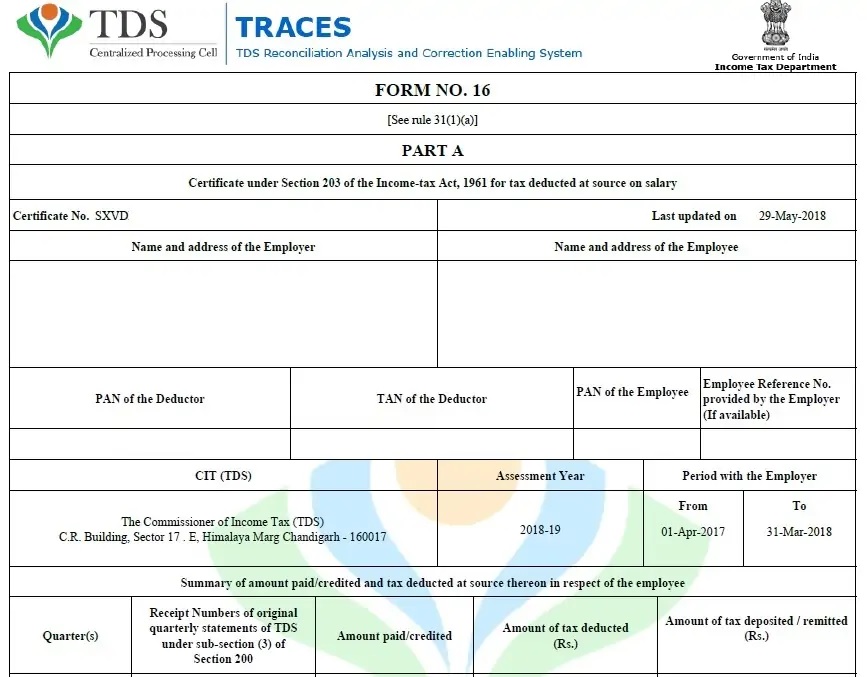
TDS on interest
TDS @ 10% is required to be deducted by the bank on the interest earned on Fixed Deposit. However, there are 2 exceptions to this:-
- No TDS is required to be deducted on interest earned on savings bank account
- No TDS is required to be deducted if the interest earned on fixed deposits is less than Rs. 10,000. This limit is Rs. 10,000 per bank. So, if a bank is paying interest on a fixed deposit which is above Rs. 10,000 (cumulative on all FDs), then they will have to deduct TDS at the rate of 10%. However, if a bank is paying cumulative interest during the whole year of Rs. 8,000 and the other is paying a cumulative interest of Rs. 7,000 during the whole year – No TDS is required to be deducted as interest payable by each bank, less than Rs. 10,000.
TDS on interest can also be reduced by filing an application in Form 15G/Form 15H with the bank which is explained here – Form 15G and Form 15H to deduct TDS on interest,
[ad_2]
Source link







Leave a Reply