

[ad_1]
Capital gains tax on sale of property in India is levied on the basis of the period for which the property was with the seller. If the asset was held for less than 2 years – it will be classified as short term capital gain and if the property was held by the seller for more than 2 years, it will be classified as long term capital gain Will go
Capital gains tax rate on sale of property
| description | tax rate |
| short term capital gains tax rate | As per normal income tax slab |
| long term capital gains tax rate | 20% |
Calculation of short-term capital gain on sale of asset
The profit at the time of sale of short-term capital asset shall be computed in the following manner:-
| full value of consideration | XXX | |
| (low) | Expenses incurred wholly and exclusively in connection with such transfer/sale | XXX |
| (low) | acquisition costs | XXX |
| (low) | cost of improvement | XXX |
| gross short-term capital gains | XXX | |
| (low) | Discount (if any) available under section 54B/54D/54G/54GA | XXX |
| Net short term capital gain on sale of assets | XXX |
Tax will be payable on the short term capital gains computed above as per the income tax slab rates.
Calculation of long term capital gains
If the asset is held for more than 2 years, it will be classified as a long-term capital gain. Following are the main advantages of being classified as long term capital gain:-
- Flat rate of 20% capital gains tax
- Benefit of indexation can also be claimed
- Various tax exemptions can also be claimed under Section 54, Section 54EC, Section 54F
The method of computing taxable long-term capital gain on sale of assets is as follows:-
| full value of consideration | XXX | |
| (low) | Expenses incurred wholly and exclusively in connection with such transfer/sale | XXX |
| (low) | indexed cost of acquisition | XXX |
| (low) | indexed cost of improvement | XXX |
| gross LTCG | XXX | |
| (low) | Discount Available u/s 54/54B/54D/54EC/54ED/54F/54G (if any) | XXX |
| Net long-term capital gain on sale of assets | XXX |
Other relevant points regarding capital gains
- advance tax Capital gains on sale of assets are required to be paid during the year, whether it is a long-term capital gain or a short-term capital gain.
- If there is a short term capital loss on the sale of an asset, the short term capital loss can be set-off against both short term and long term capital gains arising in that year. However, if the loss is of long-term nature, it can be set-off only with the long-term capital gain of that financial year and not with the short-term capital loss.
- If Loss cannot be set-off against capital gain In that year, it can be carried forward for the next 8 years and set-off in future years.
TDS on sale of property
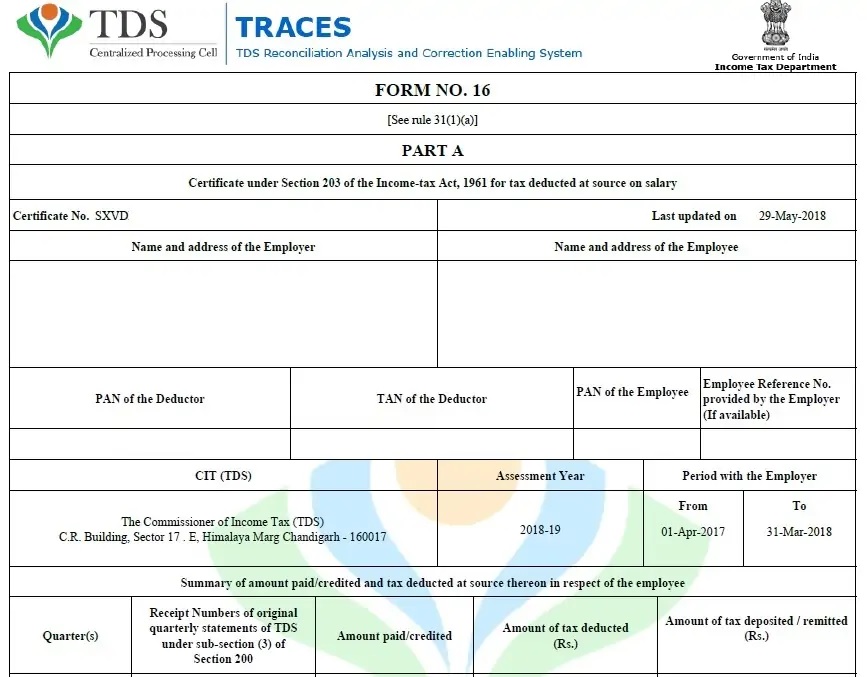
Even if it is long term capital gain on short term capital gain, TDS is applicable. TDS means tax deducted at source and is deducted by the buyer while making payment to the seller. After deducting TDS, the balance payment is made by the buyer to the seller.
TDS is not a new form of tax but a form of tax which is paid in advance and can be adjusted against the final tax liability computed at the end of the year while filing income tax return. The rate of TDS depends on whether the seller is NRI or resident and is mentioned below:-
- Seller is resident: 1% TDS will be deducted if the value of the property is more than 50 lakhs. (Ref: 1% TDS on sale of property)
- Seller is non-resident: 20% TDS will be deducted irrespective of the value of the property. Cess and surcharge will also be applicable on top of this 20%. (See: TDS on sale of property by NRI)
Meaning of the above-mentioned terms
full value of consideration
Full value of consideration means what the transferor receives or is entitled to receive as consideration estate sale /Property. This value can be in the form of cash or kind i.e. against an asset.
In the case of an asset exchange, the full value for computing capital gains shall be the fair market value of the asset(s) offered in the exchange. Fair market value in relation to capital gains means the value that the asset(s) would normally receive if it were sold on the relevant date in the open market.
If the full value of the consideration is received in installments over different years, then the full value of the consideration will be the market value of the property/property offered in exchange.
transfer cost
Expenses on transfer include any expenditure incurred directly or indirectly for the purpose of transfer such as advertisement expenses, brokerage expenses, stamp duty, registration fees and legal expenses etc., However, any expenditure which has been claimed as a deduction under any other provision of income tax act Cannot be claimed as deduction under this section.
acquisition costs
The cost of acquisition is the price that the assessee has paid, or the amount that the assessee has spent to acquire the asset/assets. Expenses incurred at the time of completing the title are a part of the cost of acquisition.
In cases where the capital asset became the property of the assessee in any of the manner mentioned below, the cost of acquisition shall be deemed to be the cost for which the previous owner of the asset acquired it:-
- Feather distribution of assets/total division of HUF
- under a gift or will
- by inheritance, inheritance or transfer
- On distribution of assets on liquidation of a company
Where the cost of the asset acquired by the previous owner of the capital asset cannot be ascertained, the cost of acquisition to the previous owner shall be the fair market value of the asset as on the date on which the asset became the property of the previous owner. interest on money Borrowing to acquire capital asset will also form a part of the cost of the asset provided the deduction for interest has not been claimed earlier.[CIT v Mithlesh Kumari (1973) 92 ITR 9 (Del)]
cost of improvement
All capital expenditure incurred by the assessee in making any addition or alteration to the capital asset after it becomes his property or the change in the capital asset by the assessee after it becomes his property shall be deductible as cost of improvement. If the asset was immediately transferred to the assessee under the matters specified above, the capital expenditure incurred by the previous owner would also be treated as cost of improvement.
However, the cost of improvements does not include any capital asset which is deductible in computation of chargeable under the head “income from household property”, “profit or gain of business or profession”, or “income from other sources”. Only capital expenditure is treated as cost of improvement and regular expenses on repair and maintenance are not part of cost of improvement.
For the purpose of computing long-term capital gains, the cost inflation index will be used to index the cost of acquisition and cost of improvement and the resulting figure will be the indexed cost of acquisition and the indexed cost of improvement for the purpose of computation. of LTCG
Indexed cost = Actual cost * year of sale cost inflation index
cost inflation index of the year of purchase
E-Book on Capital Gains Tax on Sale of Property
The value of transactions in real estate is usually very high which results in a high amount to be paid as tax. Hence due care should be taken while computing the applicable capital gains tax.
In addition, there are several legal ways to reduce this capital gains tax through proper tax planning as the government allows multiple exemptions on tax on the sale of property.
To help people plan and reduce their taxes legally, we have written a detailed e-book that explains everything on Capital Gains Tax on Real Estate Transactions in simple words with examples and case laws. The book can be bought through Contact,
The main topics covered in the e-book are:-
- Calculation of Capital Gains
- Tax on sale of inherited property
- Tax on sale of under construction property
- Sale of property below circle rate/stamp valuation rate
- How to reduce tax by claiming capital gains exemption
- TDS on sale of property
- 40+ Comprehensive Examples
More than 10,000 copies of this e-book have already been sold and you can buy it for Rs. Can also buy in 147 From this link – Buy E-Book on Capital Gains Tax
[ad_2]
Source link




Leave a Reply