[ad_1]
‘If we cannot handle an epidemic of that strata, (causing that kind) of excessive calamity, then we really have to
prevent it.’
‘If we become complacent in even
preventing it, then we are in for a disaster.
prevent it.’
‘If we become complacent in even
preventing it, then we are in for a disaster.
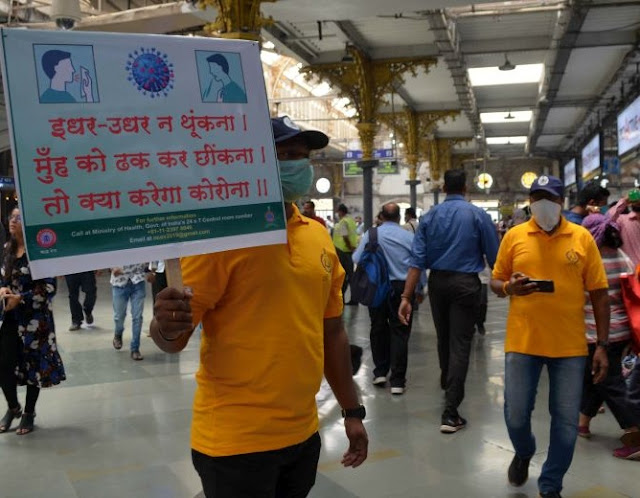
IMAGE:
A volunteer holds a placard to create awareness about COVID-19 at the
Chhatrapati Shivaji Maharaj Terminus in Mumbai.
Dr Trupti Gilada is an infectious
disease specialist at the Unison Medicare and Research Centre, south Mumbai.
She consults at the Prince Aly Khan hospital at south-central Mumbai.
disease specialist at the Unison Medicare and Research Centre, south Mumbai.
She consults at the Prince Aly Khan hospital at south-central Mumbai.
She trained at the
KEM and Nair hospitals in Mumbai and spent three years doing her fellowship in
infectious disease at Harvard. Dr Gilada has won a global award for HIV
research.
KEM and Nair hospitals in Mumbai and spent three years doing her fellowship in
infectious disease at Harvard. Dr Gilada has won a global award for HIV
research.
“We aren’t
extremely well prepared for the epidemic. We are only saying that because we’re
still at (low fatality) numbers.
extremely well prepared for the epidemic. We are only saying that because we’re
still at (low fatality) numbers.
What
exactly is the community spread of a viral pandemic like COVID-19? Has India
reached that stage yet?
exactly is the community spread of a viral pandemic like COVID-19? Has India
reached that stage yet?
The coronavirus an epidemic, or for that matter any epidemic, that spreads from one country to the
other goes through different stages.
other goes through different stages.
Stage One of the epidemic is when the cases are found only among people who travelled to that
country (that had the viral outbreak).
country (that had the viral outbreak).
Stage Two is when
we find cases amongst contacts of these travelers.
we find cases amongst contacts of these travelers.
And Stage Three is
when the disease has come into the community, which means that it’s not just in
the travelers or their contacts. It’s also now in the general community, which
means that now, if we were to screen only those who were travelers or contacts,
we would miss a lot of cases.
when the disease has come into the community, which means that it’s not just in
the travelers or their contacts. It’s also now in the general community, which
means that now, if we were to screen only those who were travelers or contacts,
we would miss a lot of cases.
So at this point,
we (in India) are just between
(Stages) Two and Three, because
all the recent cases, that we have found, have only been in travelers or in
their contacts. But we also know that what we find is probably just part of the
cases.
we (in India) are just between
(Stages) Two and Three, because
all the recent cases, that we have found, have only been in travelers or in
their contacts. But we also know that what we find is probably just part of the
cases.
Let
me just backtrack to again understand the definition of community spread. If
there’s a traveler, and he has given it to his family, so when the family gives
it to their neighbors, that still is not community spread?
me just backtrack to again understand the definition of community spread. If
there’s a traveler, and he has given it to his family, so when the family gives
it to their neighbors, that still is not community spread?
So once the neighbour
has acquired it, it is community spread.
But
I am told the community spread means when some case presents itself, where the
person doesn’t know where he’s got it from. So you’re saying it’s both?
I am told the community spread means when some case presents itself, where the
person doesn’t know where he’s got it from. So you’re saying it’s both?
In a lot of cases,
you will be able to just go back and see that: ‘Oh so this person got it from
the neighbour’s house and the neighbour were in touch with this person’.
you will be able to just go back and see that: ‘Oh so this person got it from
the neighbour’s house and the neighbour were in touch with this person’.
But once we skip,
when three or four steps have gone (missing),
and there is no way to go and say where did that happen from?
when three or four steps have gone (missing),
and there is no way to go and say where did that happen from?
And once that
happens, that is the point where — if you’ve seen the graph of any epidemic —
that is the time when the graph starts rising ie when it’s community spread.
happens, that is the point where — if you’ve seen the graph of any epidemic —
that is the time when the graph starts rising ie when it’s community spread.
We are. Even now,
they have always been able to track down the contacts and who these cases have
been in touch with.
they have always been able to track down the contacts and who these cases have
been in touch with.
But we know that is
not going to be like this for another one week. We know it is going to spill
out into the community a bit.
not going to be like this for another one week. We know it is going to spill
out into the community a bit.
But
nobody’s talking about community spread yet?
nobody’s talking about community spread yet?
The whole thing of
social distancing is because we anticipate community spread.
social distancing is because we anticipate community spread.
If we were not
anticipating community spread, there was no need of social distancing. Then
just screening travelers and quarantining them and asking them to get
self-isolated would have been enough.
anticipating community spread, there was no need of social distancing. Then
just screening travelers and quarantining them and asking them to get
self-isolated would have been enough.
The entire fact
that we are all really, really
urging on social distancing means that we anticipate that there is going to be
community spread.
that we are all really, really
urging on social distancing means that we anticipate that there is going to be
community spread.
The
way the leadership of a country deals with an epidemic and how it communicates
a message to its people is critical at these times. One has been watching how
different national leaders are tackling the crisis across the world.
The prime minister addressed the nation
when demonetisation happened. But not for this. We haven’t heard anything from
the health minister.
Do you think the leadership is stepping
up to the task?
way the leadership of a country deals with an epidemic and how it communicates
a message to its people is critical at these times. One has been watching how
different national leaders are tackling the crisis across the world.
The prime minister addressed the nation
when demonetisation happened. But not for this. We haven’t heard anything from
the health minister.
Do you think the leadership is stepping
up to the task?
So in a lot of
ways, we are slow.
ways, we are slow.
We still want to
think that we are doing everything up to the mark. And we are extremely well
prepared for the epidemic — which isn’t true.
think that we are doing everything up to the mark. And we are extremely well
prepared for the epidemic — which isn’t true.
We aren’t extremely
well prepared for the epidemic. We are only saying that because we’re still at
(low fatality) numbers.
well prepared for the epidemic. We are only saying that because we’re still at
(low fatality) numbers.
So
many government officials have been announcing that we are well prepared. And
because of that people feel it is not going be that bad.
many government officials have been announcing that we are well prepared. And
because of that people feel it is not going be that bad.
It is a good thing
to think that way and say it in the papers.
to think that way and say it in the papers.
They know that they
are not well prepared.
are not well prepared.
At least in MCGM (the Municipal Corporation of Greater Mumbai),
and or in Bombay, we know that they are really taking a lot of proactive steps
and are already planning for weeks ahead.
and or in Bombay, we know that they are really taking a lot of proactive steps
and are already planning for weeks ahead.
Like they are
coming up with plans that if this epidemic really blows up, what will be the
other labs that will be open for testing, and what will be the other hospitals
that will be utilised.
coming up with plans that if this epidemic really blows up, what will be the
other labs that will be open for testing, and what will be the other hospitals
that will be utilised.
But we also know,
it’s not just about getting the infrastructure ready. It’s also about
retraining a lot of manpower to handle this epidemic in the right way.
it’s not just about getting the infrastructure ready. It’s also about
retraining a lot of manpower to handle this epidemic in the right way.
So we really need
to accept that we are in for a disaster in the next two weeks if we really
don’t do what a lot of other countries did in a very, very regulated and a
strict manner. Like if you see what happened in Wuhan, they really, really had
a very bad peak with the epidemic.
to accept that we are in for a disaster in the next two weeks if we really
don’t do what a lot of other countries did in a very, very regulated and a
strict manner. Like if you see what happened in Wuhan, they really, really had
a very bad peak with the epidemic.
But if you see the
rest of China they were beautiful in what they did. They did see huge numbers
and they did see a lot of deaths. But they were able to do that they were able
to curve that epidemic in a span of one-and-a-half to two months.
rest of China they were beautiful in what they did. They did see huge numbers
and they did see a lot of deaths. But they were able to do that they were able
to curve that epidemic in a span of one-and-a-half to two months.
Will we be able to do
that if the epidemic comes to our country?
that if the epidemic comes to our country?
We know the answer
is no.
is no.
If we really cannot
handle an epidemic of that strata, (causing
that kind) of excessive calamity, then we really have to prevent
it. Then if we become complacent in even preventing it, then we are actually in
for a disaster.
handle an epidemic of that strata, (causing
that kind) of excessive calamity, then we really have to prevent
it. Then if we become complacent in even preventing it, then we are actually in
for a disaster.
People really
worship politicians in India. They really worship (Prime Minister) Narendra (Damodardas)
Modi and they worship some chief ministers.
worship politicians in India. They really worship (Prime Minister) Narendra (Damodardas)
Modi and they worship some chief ministers.
So I think this is
the time, that if they really come out and say that Narendra Modi is going to
address the people of India at 8 pm tonight, it’s like a big thing.
the time, that if they really come out and say that Narendra Modi is going to
address the people of India at 8 pm tonight, it’s like a big thing.
And if he tells
people to: ‘Please stay at home and this is what we really want you to follow’,
we know it will make a big impact.
people to: ‘Please stay at home and this is what we really want you to follow’,
we know it will make a big impact.
But this is not the
first time. We know that health and education really doesn’t receive that kind
of priority or attention or response from politicians the way it should. I hope
at this point, some good sense will prevail.
first time. We know that health and education really doesn’t receive that kind
of priority or attention or response from politicians the way it should. I hope
at this point, some good sense will prevail.
Let
me ask a kind of bald question. I’m holding my cell phone and I feel for sure
that a few COVID-9 viruses are on it. How do I kill them? How do I know or am
absolutely sure they are dead?
me ask a kind of bald question. I’m holding my cell phone and I feel for sure
that a few COVID-9 viruses are on it. How do I kill them? How do I know or am
absolutely sure they are dead?
How do you know
corona-virus is on your cell phone?
corona-virus is on your cell phone?
There is no way to
say where coronavirus is at this point in time.
say where coronavirus is at this point in time.
You should just
assume that corona-virus is on surfaces that are being touched by several
people, door handles, cabs and whatever.
assume that corona-virus is on surfaces that are being touched by several
people, door handles, cabs and whatever.
You know, in our in
sub-conscious mind, we just need to keep thinking that this virus is everywhere,
which will really make us
follow hand hygiene religiously.
sub-conscious mind, we just need to keep thinking that this virus is everywhere,
which will really make us
follow hand hygiene religiously.
It’s not that
difficult to kill the virus. Any disinfectant which is either alcohol- or
bleach-based is enough to disinfect surfaces.
difficult to kill the virus. Any disinfectant which is either alcohol- or
bleach-based is enough to disinfect surfaces.
So
like even like when you are washing things in the kitchen, vegetables, milk
packets?
like even like when you are washing things in the kitchen, vegetables, milk
packets?
Soap, water,
bleach. Sterillium that we use. You can take some sterillium on a tissue or
cotton and clean your cellophane. Little things. That’s enough.
bleach. Sterillium that we use. You can take some sterillium on a tissue or
cotton and clean your cellophane. Little things. That’s enough.
A
lot of educated people one talks to don’t believe that we are in a dangerous
situation. And this particular virus is a little bit more dangerous than other
viruses for various reasons.
Why does this pandemic seem to be worse
or maybe on par with previous pandemics?
Why has it gotten more out of hand with
this virus? Or is it just the nature of this virus, where people don’t actually
die and it quietly spreads. Is it
more lethal than some of these other viruses like SARS, swine flu, Ebola, bird
flu?
Is this pandemic worse than other ones?
What is your view?
lot of educated people one talks to don’t believe that we are in a dangerous
situation. And this particular virus is a little bit more dangerous than other
viruses for various reasons.
Why does this pandemic seem to be worse
or maybe on par with previous pandemics?
Why has it gotten more out of hand with
this virus? Or is it just the nature of this virus, where people don’t actually
die and it quietly spreads. Is it
more lethal than some of these other viruses like SARS, swine flu, Ebola, bird
flu?
Is this pandemic worse than other ones?
What is your view?
There are four
qualities that decide how bad the disease is going to be.
qualities that decide how bad the disease is going to be.
One is the mode of
spread. So any disease that spreads through respiratory secretions always tends
to spread faster. Because the virus is there in the cough and the sneeze, and
it’s extremely difficult to have 100 per cent hand hygiene or cough etiquette.
spread. So any disease that spreads through respiratory secretions always tends
to spread faster. Because the virus is there in the cough and the sneeze, and
it’s extremely difficult to have 100 per cent hand hygiene or cough etiquette.
The second is the
infectiousness of the virus. And that is like an innate quality or that’s like
a personality of each virus.
infectiousness of the virus. And that is like an innate quality or that’s like
a personality of each virus.
There is something
called R0 (basic reproductive rate)
which decides how infectious each virus is going to be. And that number
technically means that during the disease period, in any patient, how many
other people will this patient infect.
called R0 (basic reproductive rate)
which decides how infectious each virus is going to be. And that number
technically means that during the disease period, in any patient, how many
other people will this patient infect.
So the R0 for
corona-virus 19, the SARC-CoV2, is around three.
corona-virus 19, the SARC-CoV2, is around three.
Now, if you see a
lot of other viral diseases, like for HIV, for that matter, the R0 for HIV is
also three.
lot of other viral diseases, like for HIV, for that matter, the R0 for HIV is
also three.
So you will think
what’s so different?
what’s so different?
But the HIV
positive person will infect three people in the course of the disease, which is
an entire lifetime.
positive person will infect three people in the course of the disease, which is
an entire lifetime.
In contrast,
someone with COVID-19 will infect three people, in the course of the disease,
which is only 10 days. That means it’s such
a short span of time, three people will keep getting infected.
someone with COVID-19 will infect three people, in the course of the disease,
which is only 10 days. That means it’s such
a short span of time, three people will keep getting infected.
Now, if three
people get infected, and each of these infects another three, that’s nine, and
then another three it’s 27. So it’s like exponential.
people get infected, and each of these infects another three, that’s nine, and
then another three it’s 27. So it’s like exponential.
And because it’s in
such a short span of time, within like a matter of months, we’ve really crossed huge numbers.
such a short span of time, within like a matter of months, we’ve really crossed huge numbers.
Now that is the
infectiousness of the virus. And that’s the reason why this entire concept of
social distancing, because, we believe, that if someone who’s infected with the
virus actually doesn’t come in contact with that many people, we are basically
trying to bring down the R0.
infectiousness of the virus. And that’s the reason why this entire concept of
social distancing, because, we believe, that if someone who’s infected with the
virus actually doesn’t come in contact with that many people, we are basically
trying to bring down the R0.
So instead of three
people getting infected, we really want zero or one person to get infected, so
that’s the aim (with regard to)
the infectiousness of the virus.
people getting infected, we really want zero or one person to get infected, so
that’s the aim (with regard to)
the infectiousness of the virus.
And the third
quality of the virus is the mortality rate or the case fatality rate. And the
case fatality rate is out of hundred people who get infected with COVID-19, how
many of them are going to succumb to COVID-19.
quality of the virus is the mortality rate or the case fatality rate. And the
case fatality rate is out of hundred people who get infected with COVID-19, how
many of them are going to succumb to COVID-19.
And this case fatality
rate, if you see, this number has changed from country to country like South
Korea clearly has a very low case fatality rate.
rate, if you see, this number has changed from country to country like South
Korea clearly has a very low case fatality rate.
What China saw was
between 2 to 4 per cent. The fatality rate in South Korea was 1 per cent.
between 2 to 4 per cent. The fatality rate in South Korea was 1 per cent.
What we are
actually seeing in Italy is around 6 per cent.
actually seeing in Italy is around 6 per cent.
Because
of the higher population older people?
of the higher population older people?
Yes. So the case
fatality rate also depends on a lot of things. It depends on what the age
structure of the population is, how good your healthcare system is.
fatality rate also depends on a lot of things. It depends on what the age
structure of the population is, how good your healthcare system is.
Sometime the
healthcare system will be great. But if it is over-challenged, so there are
just too many people reaching the healthcare system beyond what the hospital
can handle, then the entire system just collapses.
healthcare system will be great. But if it is over-challenged, so there are
just too many people reaching the healthcare system beyond what the hospital
can handle, then the entire system just collapses.
So if I was to
receive five people in the ICU, I can offer really good care to five. But
instead of five if I start receiving 15 on the same day, then I know that the
care will be compromised.
receive five people in the ICU, I can offer really good care to five. But
instead of five if I start receiving 15 on the same day, then I know that the
care will be compromised.
And that’s the
reason why they really want to flatten the curve (COVID-19 case curve). That’s the entire concept of flattening
the curve — you don’t want that peak to be really high.
reason why they really want to flatten the curve (COVID-19 case curve). That’s the entire concept of flattening
the curve — you don’t want that peak to be really high.
The higher the
peak, the more number of people who will reach the hospital and the more
over-burdend the health system will be.
peak, the more number of people who will reach the hospital and the more
over-burdend the health system will be.
Because of this
infectiousness: So SARS was like an epidemic that spanned over six months. And
even over six months, the cases were not as much as what corona saw just in a
matter of one-and-a-half months.
infectiousness: So SARS was like an epidemic that spanned over six months. And
even over six months, the cases were not as much as what corona saw just in a
matter of one-and-a-half months.
But at the same
time, it hasn’t killed, percentage-wise, that many people.
time, it hasn’t killed, percentage-wise, that many people.
In Ebola, the fatality rate was 50 per cent and some countries saw 70 and 80 per cent, which
was dangerous.
was dangerous.
With COVID-19, we
know that, at most, it has been 5 to 6 per cent.
know that, at most, it has been 5 to 6 per cent.
[ad_2]
Source link


